![]() |
|
||||||||||||||||
![]() |
A common experience
Many people who wear helmets can relate their experience of a crash which
leads them to believe that a helmet 'saved their life'. This is a very common
experience - very much more common, in fact, than the actual number of
life-threatening injuries suffered by bare-headed cyclists. Yet there is no evidence that
helmets save lives or prevent serious injury at all across cyclists as a whole [1].
For example, in the state of Western Australia where bicycle helmets have been mandatory for all ages since July 1992, the annual cyclist death toll from 1987 to 1991 (pre-law) averaged 7.6 fatalities per year. From 1993 to 1997 (post-law) it was 6.4 fatalities per year, representing a 16% reduction [2]. However, Government cycling surveys show cycling declined in Western Australia by approximately 30% during the 1990s following mandatory helmet law enforcement [3]. Thus, relative to cycle use, fatalities went up, not down.
Why this contradiction?
These facts appear contradictory and counter-intuitive, but there are
several possible explanations.
There is a good deal of circumstantial evidence that helmeted cyclists are more likely to crash, and data from one study [4] suggests that those wearing a helmet are more than 7 times likely to hit their heads if they do.
Many falls result in arm and shoulder impacts that keep an unhelmeted head just clear of the ground. A helmeted head, being twice as big and a little heavier, is more likely to hit something.
Another possibility concerns so-called 'risk compensation' - the tendency or willingness of people to take greater risks when they feel better protected. There is clear evidence of this, particularly amongst children, and it is quite likely to be a subconscious reaction. If people take greater risks (such as riding in places requiring a higher level of skill) due to a misplaced belief that their helmet makes them safer, they could be more likely to experience a crash.
The movement of a helmet or the irritation to the head that many people experience might also affect balance or concentration at a crucial moment.
But my helmet broke - isn't that proof?
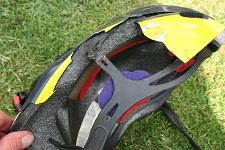
A helmet is a fragile piece of equipment. On seeing a damaged one, it is easy to assume that a serious injury has been prevented. Cycle helmets split very readily, and often at forces much lower than those that would lead to serious head injury. Helmets work by absorbing impact energy through the crushing of an expanded polystyrene liner. Once compressed the liner stays compressed. It does not bounce back to its original form like reusable helmets for some other activities. If a helmet splits before the liner has partially or fully compressed - and this is often the case - then it has simply failed. It will not have provided the designed protection and may in fact have absorbed very little energy at all.
If a helmet splits after fully compressing, it will have reduced initial forces to the head, but thereafter it will afford no further protection and any residual energy will be transmitted to the brain. Cycle helmets fail catastrophically, not gradually, so it is a mistake to believe that they provide useful, if reduced, protection at higher velocities. In high impact crashes, such as most that involve motor vehicles or fixed vertical objects like concrete barriers and lamp posts, the forces are so great that a helmet will compress and break in around 1/1000th of a second. The absorption of the initial forces during this very short period of time is unlikely to make a significant difference to the likelihood of serious injury or death.
Helmets provide some protection when there is only partial compression of the liner and they may work better if in addition there is no split or breakage. This is most likely to be the case in crashes that result from low-speed falls without any third party involvement and where, without a helmet, injury would be relatively minor. If the liner suffered no compression, the helmet almost certainly played no role in preventing injury and without the helmet there would have been no injury of consequence anyway.
| For more information about how helmets work, see: Heads up - the science of helmets |
| See also: | The experience of a solicitor specialising in cycling injuries |
| Medical opinion in litigation |
References
[1] see: What evidence is there that cycle helmets save lives and
What evidence is there that cycle helmets reduce serious injury.
[2] Meuleners LB, Gavin AL, Cercarelli LR, Hendrie D. Bicycle Crashes and Injuries in Western Australia 1987-2000 RR131; Injury Research Centre, School of Population Health, The University of Western Australia, November 2003.
See also: Cyclist injury data before and after
helmet law in Western Australia. ![]()
[3] Main Roads WA official surveys of cyclist numbers, primarily those relating to the major Narrows and Causeway bridge locations.
See also: Bike numbers in Western Australia: Government surveys. ![]()
[4] Wasserman RC, Waller JA,
Monty MJ, Emery AB, Robinson DR. Bicyclists, helmets and head injuries: a
rider-based study of helmet use and effectiveness. 1988. American Journal of Public Health: 1988
Sep;78(9):1220-1
|
|
||