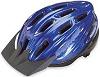
Cycle helmets and rotational injuries
Minor head injuries are usually as a result of linear acceleration of the skull by impact with another object. Cycle helmets may produce benefit by reducing and spreading this force.
More serious injuries, on the other hand, are often as a result of angular or rotational acceleration, which leads to diffuse axonal injury (DAI) and subdural haematoma (SDH). These are the most common brain injuries sustained by road crash victims that result in death or chronic intellectual disablement.
Cycle helmets are not designed to mitigate rotational injuries, and research has not shown them to be effective in doing so.
To the contrary, some doctors have expressed concern that cycle helmets might make some injuries worse by converting direct (linear) forces to rotational ones. These injuries will normally form a very small proportion of the injuries suffered by cyclists, but they are likely to form a large proportion of the injuries with serious long-term consequences. In this way helmets may be harmful in a crash, but this harm may not be detected by small-scale research studies.
Thorough treatment of this subject, with comprehensive references, is to be found in the following article:
Curnow WJ. The efficacy of bicycle helmets against brain injury. 
Accident Analysis and Prevention, 2003,35:287-292.
See also